Product Capabilities
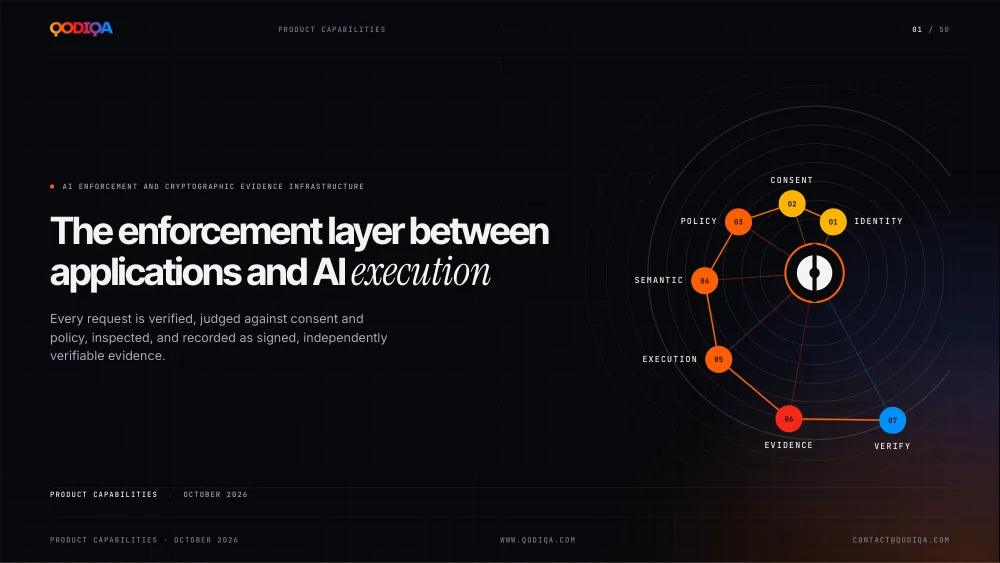
Every request is verified, judged against consent and policy, inspected and recorded as signed, independently verifiable evidence.
PDF · 50 pages · 2.7 MB · October 2026
Download PDF
 EU AI ActRegulation (EU) 2024/1689GDPRRegulation (EU) 2016/679DORADigital operational resilienceNIS2Network and information securityEU Cyber Resilience ActRegulation (EU) 2024/2847
 CoE AI ConventionFramework Convention, CETS 225
 NIST AI RMFAI Risk Management Framework 1.0
 OECD AI PrinciplesCouncil Recommendation
 SOC 2AICPA Trust Services Criteria
 ISO/IEC 42001AI management system standardISO/IEC 27001Information security management
About
Mission and vision
qodiqa is open infrastructure that puts a control point in front of an AI provider. Most systems log what an AI did after the fact. qodiqa decides before the call: a request must carry signed, time-limited consent, a defined policy evaluates it, and only then is the provider called.
Every decision, allowed or refused, becomes a signed receipt in a tamper-evident chain, and the intent is written before the provider is reached. If the system fails, it fails closed: no valid consent, no call.
The mission is to make consent, control and accountability enforceable at the moment an AI system acts, not merely promised in a policy or assumed from an earlier approval, and to make the evidence checkable by anyone, offline, without an account and without trusting us.
The foundations of trustworthy AI should be open, interoperable and accessible. That is why the specification, the gateway and the verifier are published openly, and why public test vectors let independent implementations check themselves against the same results.
Our vision is simple: trust should not depend on promises. It should be built into execution, backed by evidence and open to verification.
Principles
Consent evaluation yields a binary, reproducible outcome on every execution. No probabilistic fallback.
Enforcement is applied at the inference boundary, before any output is generated or any downstream action is taken.
If consent cannot be verified, execution halts. The system does not degrade to permissive operation.
Each decision is cryptographically signed and independently verifiable outside the enforcing system.
Consent is evaluated against a defined execution scope. Operations outside that scope are blocked.
A consent artifact cannot be modified once issued and recorded. Any change requires a new artifact with its own identifier.
Standard and implementation
Anyone can build an implementation. Anyone can verify its evidence.
Defines what enforcement must do.
Read the specificationThe reference implementation, with its capabilities and limits documented openly.
See the gatewayChecks evidence against the published protocol, independent of the gateway’s code.
Open the verifierThe rules are open, enforcement is explicit, and the evidence can be independently verified.
Founder
AI must not be left uncontrolled. And control that comes after execution may come too late.
I founded qodiqa on a simple conviction: as AI becomes capable of making decisions, accessing systems and executing actions on its own, trust alone is no longer enough. We cannot build the future of AI on policies that exist only on paper, safeguards that can be bypassed, or audit trails that explain what happened only after the consequences have occurred. Control must exist where execution happens, before an action is allowed to proceed.
My vision is a future in which AI systems are not merely expected to follow rules but are technically constrained by them: every controlled action has a defined authorization, every decision leaves verifiable evidence, and verification does not depend on trusting the system being examined. I do not want to slow AI down. I want its progress to last, and I want trust to be something that can be tested, not another promise.
“Rather than debating AI’s technical limitations, we must examine what it was empowered to do, who authorized it, when, and whether any third party possesses the evidentiary basis to confirm it.”
Work with qodiqa: see Careers.
Every request is verified, judged against consent and policy, inspected and recorded as signed, independently verifiable evidence.
PDF · 50 pages · 2.7 MB · October 2026
Download PDF